The Style Guide · Hollywood Regency
Hollywood Regency Decor: How to Get Auggie's High-Gloss Glamour
Auggie treats every entrance like a red carpet, and his high-gloss, jewel-toned rooms prove that glamour never whispers.
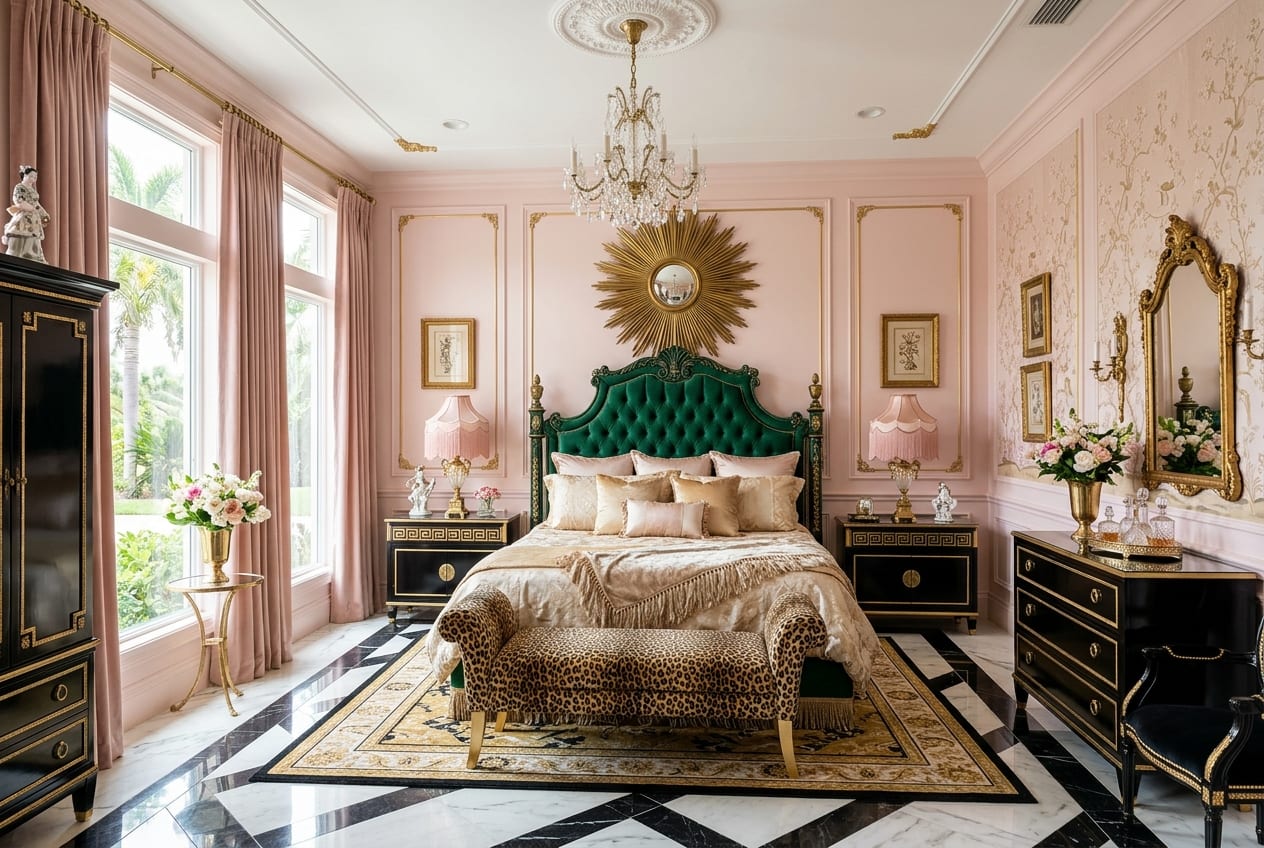
What is Hollywood Regency?
Hollywood Regency is maximalism in a tuxedo—unapologetically glamorous, deeply theatrical, and always ready for its close-up. This is the style that asks 'why have one mirror when you could have seven?' and answers its own question by hanging a sunburst above each one. Born from the belief that every room should feel like a movie set, Hollywood Regency layers high-gloss finishes, jewel tones, and metallic accents with the confidence of someone who knows the lighting is always flattering. It is formal without being fussy, opulent without being overwrought, and it never, ever apologizes for being too much.
The style emerged in Hollywood's Golden Age of the 1930s and 40s, when legendary decorator Dorothy Draper and designer William Haines transformed the homes of movie stars into sets worthy of their occupants. Haines, who left acting to become Hollywood's most sought-after decorator, pioneered the mix of neoclassical elegance and modern glamour that defines the look. He understood that stars needed homes as dramatic as their screen personas, blending Greek key patterns, lacquered furniture, and mirrored surfaces with a boldness that felt both timeless and utterly of-the-moment. The style drew from Art Deco's geometry, Regency England's classical motifs, and a distinctly American confidence that bigger is always better.
People love Hollywood Regency now because it offers permission to be unabashedly extra in a world that often asks us to minimize and edit. In an era of beige minimalism, Auggie's emerald velvet and black lacquer feel like a rebellion wrapped in good manners. This style understands that glamour is not about expense—it is about intention, about treating your Tuesday morning coffee like an Oscar acceptance speech. It appeals to anyone who has ever wanted their home to feel like an event, who believes that a little drama makes life infinitely more interesting, and who knows that the best rooms, like the best performances, leave an impression.
The signatures
- Black lacquer furniture with mirror-bright finishes
- Jewel-tone velvets in emerald, sapphire, and ruby
- Polished brass and gold accents on every surface
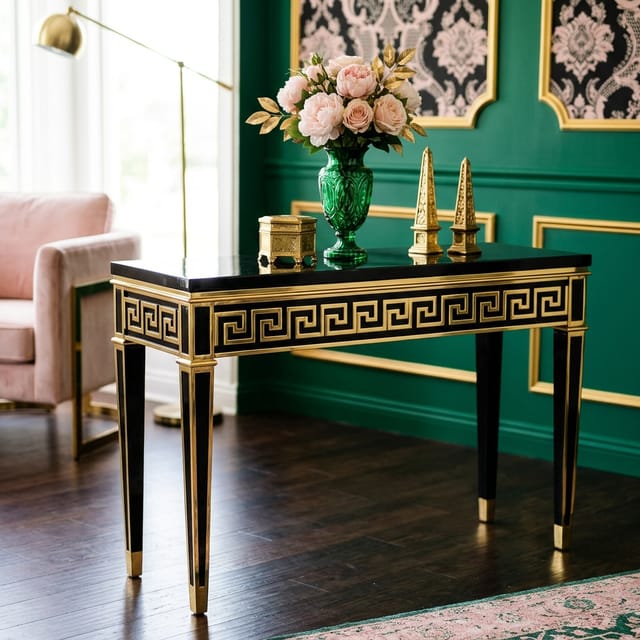
- Greek key, chinoiserie, and geometric patterns
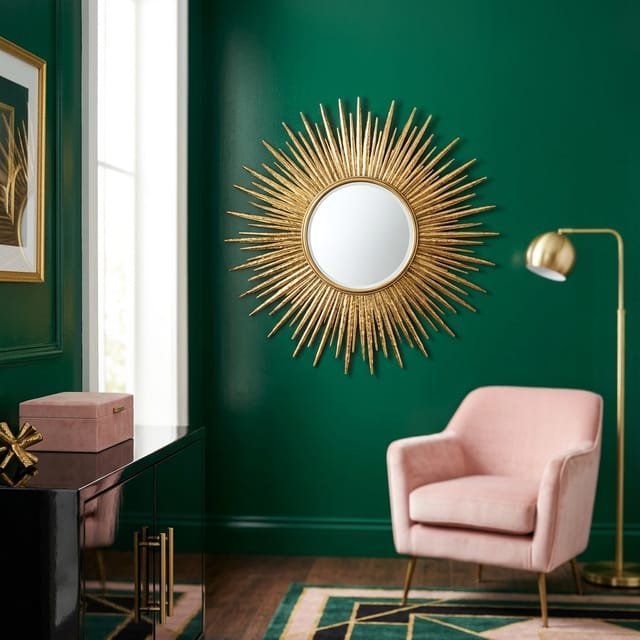
- Mirrored furniture and oversized decorative mirrors
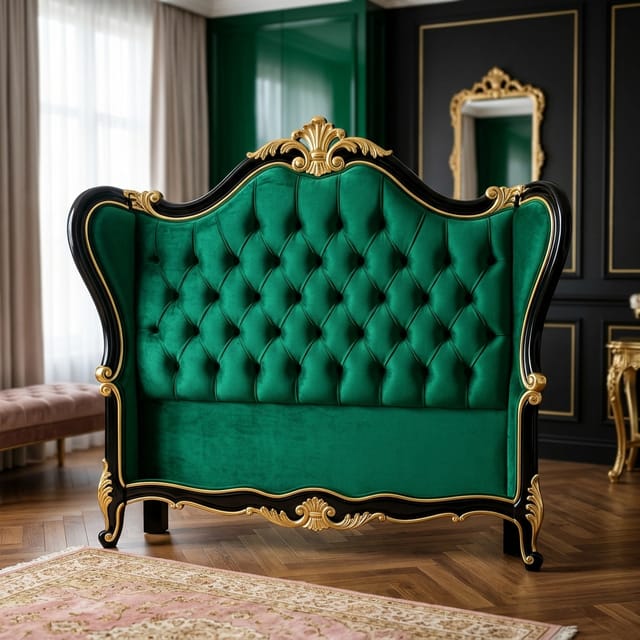
- Tufted, sculptural furniture with dramatic silhouettes
Anatomy of the look
Color & Paint
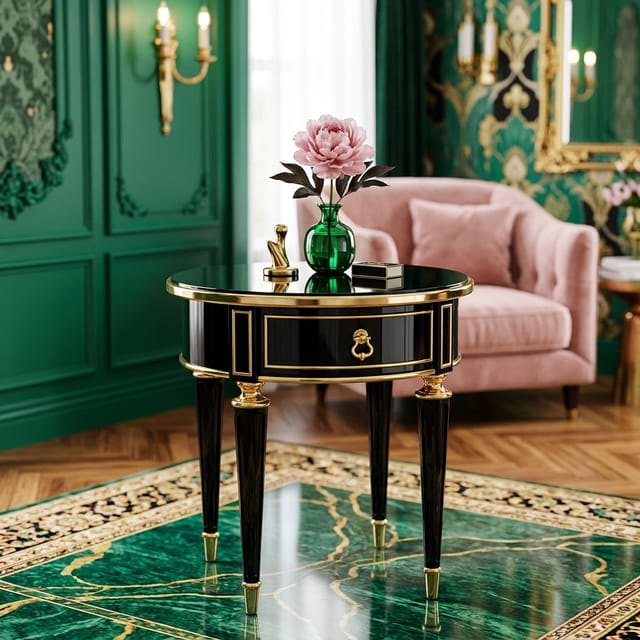
Auggie's palette is a study in contrasts—high-gloss black lacquer walls meet soft powder blush ceilings, while emerald green appears in saturated, jewel-box intensity. The black provides drama and makes every metallic accent pop like a camera flash, while blush softens the theatricality just enough to keep it livable. Gold is not an accent here; it is a supporting actor, appearing in trim, hardware, and frame details that catch light from every angle.
Walls & Pattern
Pattern in Hollywood Regency is geometric, graphic, and unafraid of scale—think oversized Greek key borders, chinoiserie wallpaper with peacocks the size of house cats, or bold black-and-white stripes that make walls look taller and rooms look like they are ready for a photoshoot. Auggie layers pattern strategically, using it on one statement wall or in unexpected places like the inside of a bookcase or the back of a bar cart. Mirrors are treated as architectural elements, hung in multiples or oversized to multiply light and space.
Furniture & Shapes
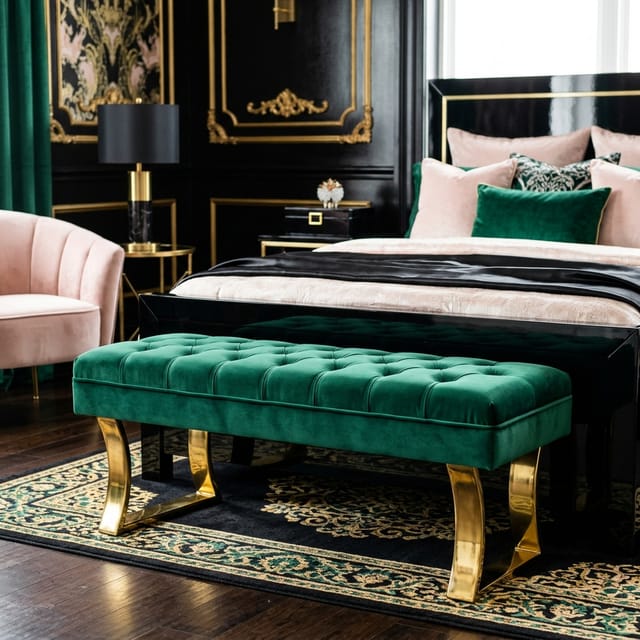
Furniture here has presence—it is sculptural, tufted, and often reflective, with silhouettes borrowed from neoclassical design but executed in modern materials. Auggie favors pieces with curves and angles that photograph well from every side: barrel-back chairs, X-base benches, waterfall console tables, and anything with acrylic or mirrored panels. Lacquered finishes are essential, turning ordinary furniture into objets d'art that reflect light and color like a hall of mirrors.
Textiles
Velvet is the undisputed star of Auggie's textile wardrobe, appearing in saturated jewel tones on sofas, pillows, and curtains with a lusciousness that begs to be touched. Silk, satin, and faux fur add textural variety while maintaining the luxe factor, and even cotton gets the glamour treatment through high thread counts and subtle sheens. Patterns lean toward damask, ikat, and animal prints rendered in sophisticated colorways—leopard in emerald and gold, never tan and brown.
Lighting
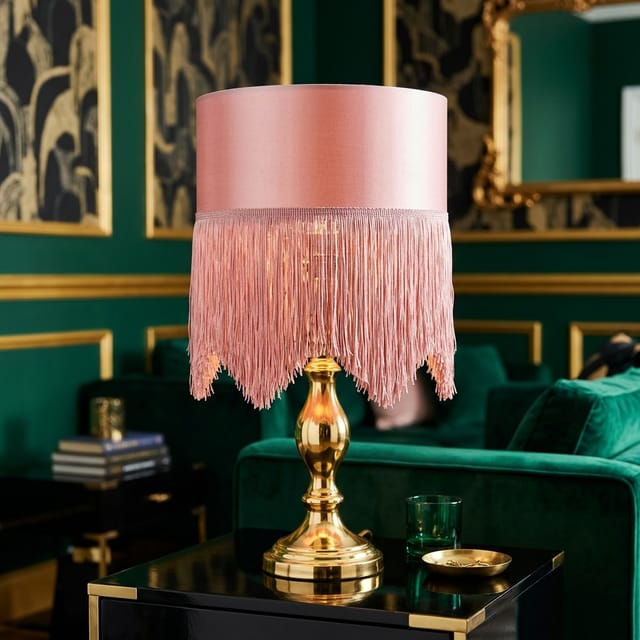
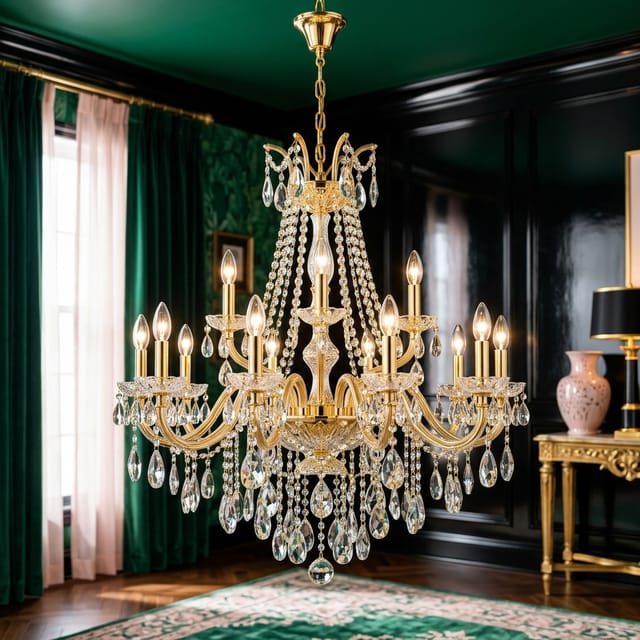
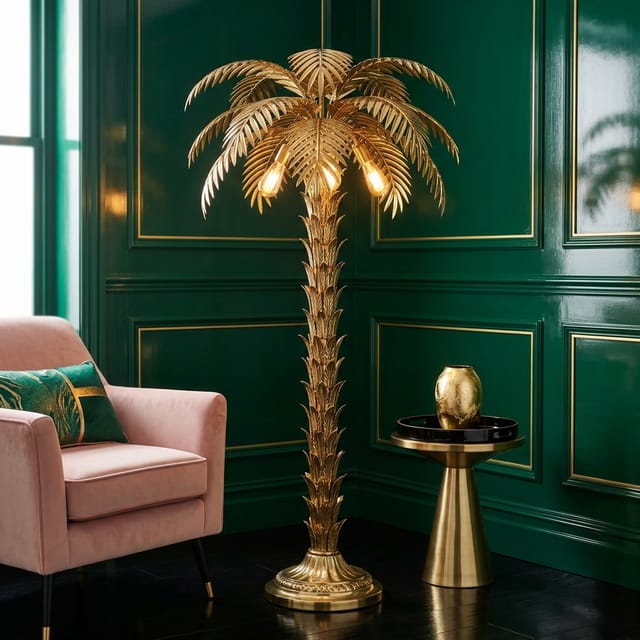
Lighting in Hollywood Regency does not illuminate—it performs, with chandeliers dripping crystals, sconces shaped like palm fronds or Greek columns, and table lamps that are sculptures first and light sources second. Auggie believes in layering light sources at multiple heights, ensuring that every corner has its own spotlight and every surface catches a gleam. Brass and gold finishes dominate, often paired with white or black shades that keep the focus on the fixture itself.
Collections & Accessories
Accessories are where Auggie's personality truly shines—lucite trays, gold-rimmed barware, stacks of glossy coffee table books, and decorative objects that look like they belong in a museum gift shop (in the best way). Mirrored or metallic surfaces multiply throughout the room in picture frames, boxes, and sculptural objects. Fresh flowers appear in crystal or brass vessels, always dramatic blooms like peonies, orchids, or calla lilies that match the room's sense of occasion.
Plants & Flowers
Greenery in Auggie's world is architectural and statement-making—think fiddle leaf figs in glossy black or gold planters, bird of paradise with dramatic leaves, or palms that add a touch of Old Hollywood exoticism. Fresh flowers are essential and always abundant, arranged in crystal vases or gold compotes with the lushness of a 1940s film premiere. Even faux botanicals get the glamour treatment, displayed in vessels that are objets d'art in their own right.
The recipe
The Auggie Formula
- 160% high-gloss black or deep jewel tones (emerald, sapphire) for drama and depth
- 230% soft neutrals (blush, cream, white) to give the eye a place to rest
- 310% polished gold and brass to catch light and add red-carpet glamour
- 4At least three reflective surfaces per room—mirrors, lacquer, glass, or metallics
Paint picks
Powder Blush #F4C9D0
Ceilings, inside bookcases, or a soft accent wall to balance the drama
Emerald #0B5D4A
Statement walls, built-ins, or the back of a bar cart for jewel-box richness
Black Lacquer #141414
High-gloss walls, trim, or furniture for maximum light-reflecting drama
Polished Gold #D4AF37
Ceiling trim, door frames, or furniture details for Old Hollywood glamour
Room by room
Living Room
Anchor the space with a velvet sofa in emerald or sapphire, then layer in mirrored side tables, a brass bar cart, and a crystal chandelier that makes every gathering feel like an event. Group mirrors of different shapes on one wall to multiply light and create instant architecture.
Bedroom
Start with a tufted velvet headboard and flank it with mirrored nightstands and crystal lamps for symmetrical glamour. Paint the ceiling in soft blush to create a flattering glow, and hang heavy velvet curtains that puddle on the floor for maximum drama.
Kitchen & Dining
Bring Hollywood Regency to the dining room with a lacquered table, brass pendant lighting, and chairs upholstered in jewel-tone velvet. In the kitchen, add gold hardware, a mirrored backsplash, or open shelving backed with emerald paint to display gold-rimmed glassware.
Bathroom
Transform a bathroom with high-gloss black walls, gold fixtures, and a large ornate mirror that makes the space feel like a powder room at the Ritz. Add crystal sconces, a lucite vanity stool, and plush white towels edged in gold for spa-level glamour.
Small Spaces & Rentals
Use mirrors strategically to double your square footage visually, and choose one or two high-impact pieces like a velvet chair or brass floor lamp rather than filling the space. Removable wallpaper in a Greek key or chinoiserie pattern on one wall creates instant drama without commitment.
Get it on any budget
Under $200
Under $500
Splurge
Renter-friendly
- Use removable wallpaper in bold patterns like Greek key or chinoiserie on one accent wall for instant glamour without the commitment
- Invest in statement furniture pieces like a velvet chair or mirrored console that you can take with you, rather than permanent installations
- Swap out basic light fixtures for plug-in sconces or statement table lamps that do not require hardwiring
- Layer removable gold trim tape along boring builder-grade doors and mirrors to add architectural detail that peels off cleanly
Easy to avoid
- Using too many finishes at once—stick to lacquer, mirror, and brass rather than adding chrome, copper, and pewter to the mix
- Forgetting the soft counterweight—without blush, cream, or white to balance the drama, the room can feel more nightclub than home
- Choosing small-scale patterns when this style demands bold graphics—a timid Greek key border will not give you the impact you want
- Skipping the high-gloss finish on paint or furniture, which is where the light-reflecting magic happens and what separates Hollywood Regency from just 'fancy'
FAQ
What is Hollywood Regency style?
Hollywood Regency is a glamorous maximalist style that emerged during Hollywood's Golden Age, characterized by high-gloss finishes, jewel-tone velvets, mirrored furniture, and polished brass accents. It blends neoclassical elegance with Art Deco drama, creating rooms that feel like movie sets—theatrical, luxurious, and always ready for their close-up.
How do I make Hollywood Regency work in a small space?
Focus on mirrors and reflective surfaces to visually expand the space, and choose one or two statement pieces rather than filling every corner. A single mirrored console, a velvet chair, and a brass mirror can deliver full Hollywood Regency impact without overwhelming a small room. Use high-gloss paint strategically on one wall or built-in to add depth.
Can Hollywood Regency style work on a budget?
Absolutely—the look is more about finish and attitude than price tags. Spray paint thrifted furniture in high-gloss black or gold, add velvet pillow covers to existing sofas, and use removable wallpaper for pattern impact. Mirrors from discount stores look expensive when grouped together, and brass-finish accessories are widely available at accessible price points.
What colors are best for Hollywood Regency decor?
The classic palette centers on black lacquer, emerald or sapphire velvet, polished gold, and a soft neutral like blush pink or cream. The contrast between dark drama and light softness is essential—you need both the jewel tones and the breathing room. Avoid muddy or muted tones, which work against the style's high-gloss, high-impact nature.
How is Hollywood Regency different from Art Deco?
While both styles share a love of glamour and geometric patterns, Art Deco is more streamlined and angular, while Hollywood Regency adds neoclassical curves, chinoiserie influences, and a more eclectic, layered approach. Hollywood Regency also embraces more color—especially jewel tones—and tends toward plush, tufted comfort where Art Deco favors sleek lines. Think of Hollywood Regency as Art Deco's more theatrical, slightly more comfortable cousin.
Some links may earn MAX by Design a small commission at no cost to you.